By: Adaevia Jones
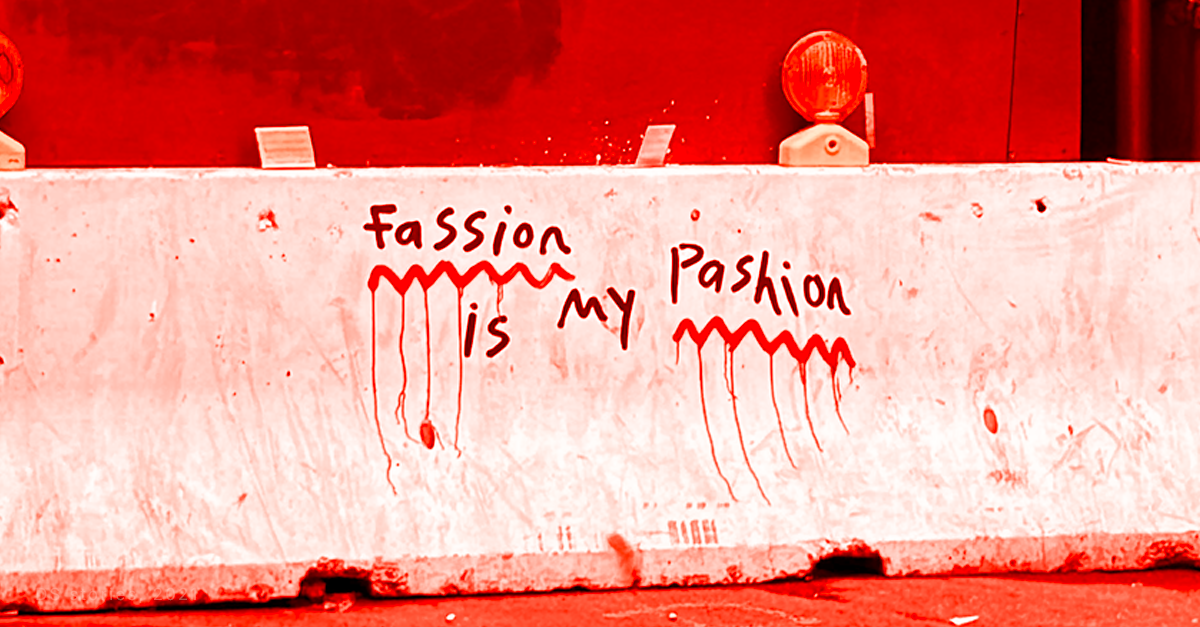
During the fashion weeks of the past few years in London, Paris, and New York, pedestrians have repeatedly stopped to examine a wall streaked with uneven black letters spelling ‘FASSION IS MY PASHION’. At first glance, it looks like a careless mistake or a meme from the internet. However, the misspelling and messy font are intentional; it marks the work of the British-Punjabi graffiti artist Navinder Nangla, whose art comments on who gets to participate in fashion and who does not.
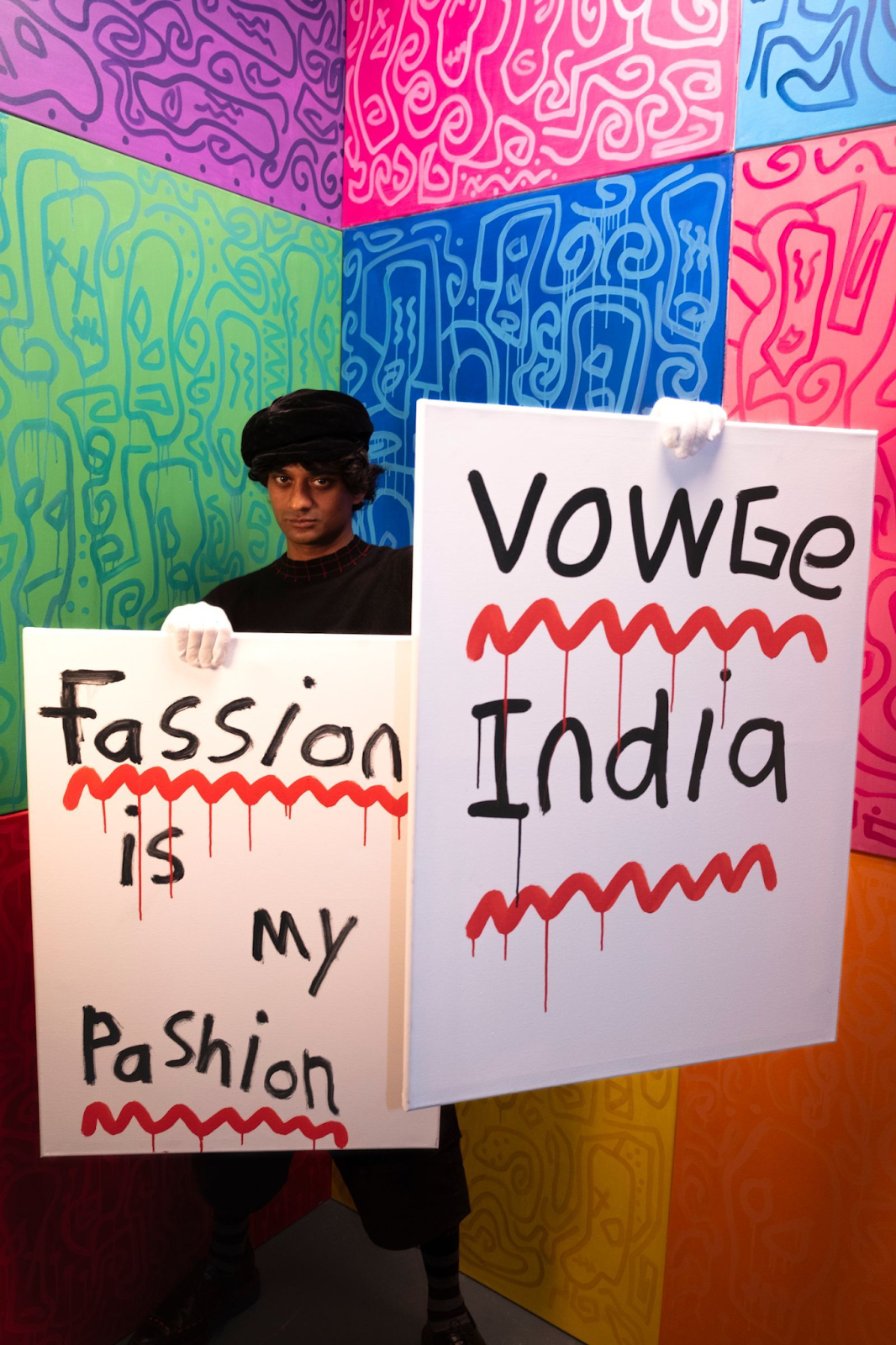
To comprehend the purpose of Nangala's street art better, it is essential to know his past. Nangla was raised in a working-class British-Punjabi household. In an interview with the BBC, he stated that “Growing up, we didn’t have a lot… My brother and I had to be creative to make things work. I used chalk and spray paint to make football goals. We would use mango cartons as the wickets for cricket" (Aftab,2022). In his childhood, he also struggled with dyslexia. What worsened his situation was the negative connotations and stigma of dyslexia in his community (Aftab 2022). In an interview with Marcus Mitropoulos from Pause Online Magazine, Nangala admitted that he studied fashion because it “had more substance” and was “easier to explain to parents" (Mitropoulos, 2025). However, his true passion was art. Therefore, he combined fashion and art into his work, which has become an iconic, subversive visual identity and an act of reclaiming language on his own terms.
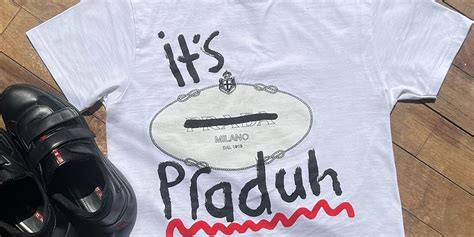
Fashion tends to rely on precision; areas like typography, imagery, tailoring, and branding are carefully orchestrated to produce a sense of cohesion and control. Therefore, a shaky handwritten phrase with dripping ink stands out instantly. Nangla’s letters drip, wobble, and are a stark contrast to the persistent symmetry that usually defines fashion’s identity. In doing so, it functions similarly to what Dick Hebdige in “Subculture: the meaning of style” describes as subcultural style, an aesthetic tactic that resists dominant cultural narratives through visual confrontation (Hedbige 1979). Fashion designs are often extremely polished, yet Roland Barthes, in his book “The Fashion System,” states that the language in the fashion world is also constructed and conscientiously controlled (Barthes,1990). His other slogans, such as ‘PRADUH’ and ‘ARHH MANI’, are a direct parody of luxury branding. His humor critiques by breaking the most basic rule: spelling. Furthermore, his art asserts that authenticity is also in human error.
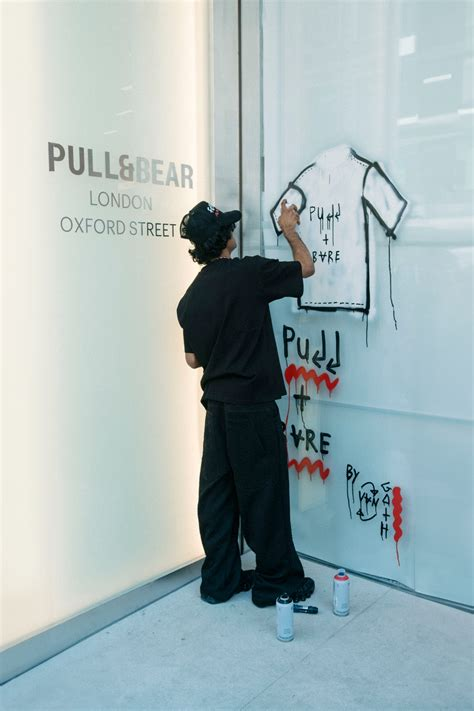
Ironically, the industry he critiques embraces him. His collaborations and pop-ups demonstrate how fashion transforms rebellion into an aesthetic. For example, he recently collaborated with in pull&bear, 4, and he flipped the L’s backward and drew them to look like arrows (Mitropoulos, 2025). Now, they appear like they are pulling something like the name in the brand suggests. He then switched Bear to BARE and turned the A upside down. A second collaboration he had was with Convers, where he spelled the brand name like CON-VS_. (DAS, 2023) This tension between the critiques and participation allows his work to have relevance when the boundaries between high fashion, street culture, and digital culture are increasingly blurred.
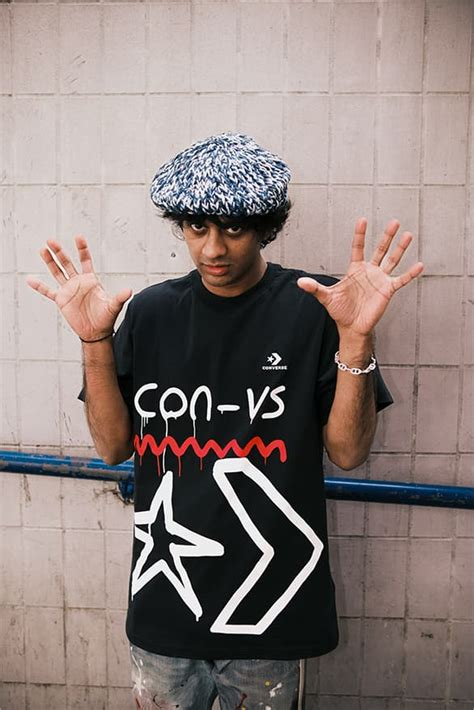
Nangala graffiti mirrors digital humor and the emotional informality of online language. His slogans, particularly, “Fassion is my passion" feel like a hashtag projected onto a physical space. This connection to everyday digital expression explains why younger audiences, exhausted by overcurated branding, gravitate toward Nangla’s art.
Ultimately, Nangla’s work suggests that passion - real passion - is rarely polished. It is uneven, chaotic, unbalanced, and unedited. In an era where fashion imagery is increasingly perfected through artificial intelligence and digital editing, Nangla’s handwriting reaffirms the value of the human mark. It insists that imperfection is not merely acceptable but meaningful. Nangala isn’t the only one who comments about the "humanness” of art. Mihara Yashihioro's fashion comments on the way people often hide their true persona (Andrea, 2025). Yashihioro explained that to do this, he uses 4 sleeved jackets and a reconfigured shirt. The article clarified that this fashion style comments on the “many ways we present ourselves, shaped by mood and circumstance.” Perhaps, the future of fashion is not only flawless, but more human. Perhaps it will unveil to its audience the things we refuse to admit about ourselves.
References
Andrea, N (2025, July 23).Mihara Yasuhiro’s Spring/Summer 2026. Yokogao Magazine https://www.yokogaomag.com/editorial/mihara-yasuhiros-spring/summer-2026-
Aftab, K. (2022, December 30).Gucci & Paris Fashion Week: How my dyslexia made me an artist. BBC. https://www.bbc.com/news/newsbeat-64028082
Barthes, R. (1990). The fashion system. University of California Press https://www.scribd.com/document/253590827/Barthes-Roland-The-Fashion-System
Das, U. (2023 ,November 28). Navinder Nangla is the graffiti artist taking over the streets at Fashion Week. Vogue. https://www.vogue.in/content/navinder-nangla-is-the-graffiti-artist-taking-over-the-streets-at-fashion-week:
Hebdige, D. (1979). Subculture: The meaning of style. Methuen & Co. Ltd. https://www.erikclabaugh.com/wp-content/uploads/2014/08/181899847-Subculture.pdf
Mitropoulos, M. (2025, April 17). Creatives in Practice: Navinder Nangla for Pull&Bear. Pause. https://pausemag.co.uk/2025/04/navinder-nangla-interview-ad/