By: Yifang Xia
From November 14, 2024 to May 25, 2025, the exhibition Digital Witness: Algorithmic Spaces for Typography and Language was held exploring how algorithmic thinking and computational processes are reshaping typography and language. Instead of presenting creativity as pure human endeavor, the exhibition framed it as an ongoing dialogue between people and machines, where authorship is shared rather than singular (ArtCenter College of Design, 2024).
Across the exhibition, artists experimented with a wide range of non-traditional methods. These included text prompts and training datasets, but also extended to physical movement and live data (Hoffmitz Milken Center for Typography [HMCT Center], 2024). In other words, type was no longer something simply designed and fixed on a page. It responded, evolved, and sometimes behaved in ways that surprised even its creators.
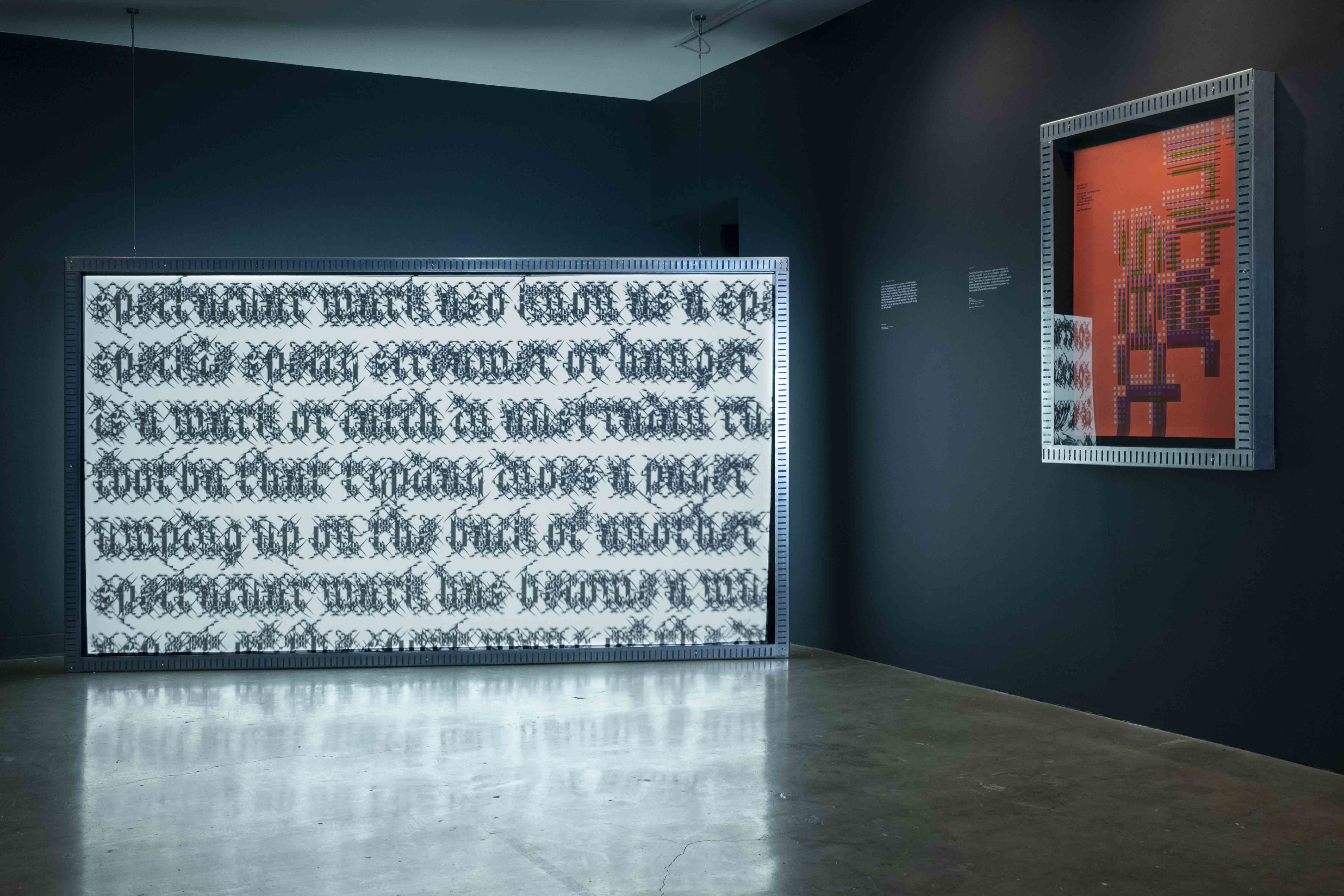
This exhibition and the typographic experiments it presented offer an entry point into algorithmic typography.
Before stepping into this topic, it helps to pause and clarify what an algorithm is. Early computer science defines an algorithm as “logic + control” (Kowalski, 1979): a way of selecting strategies for problem-solving based on logical conditions. Put simply, an algorithm is a set of rules in the computer that determines what happens next.
"What really matters is that you think about how to communicate with the computer, how to communicate your idea…because it’s not really the technology that is going to make things happen, it really is human thinking…like you would have a different calligraphy tool."
- Lynne Gun (Typographics, 2022)
In short, algorithmic typography uses computational rules or algorithms to generate or shape typographic forms. These forms emerge from computational logic and leverage concepts from generative design, artificial intelligence, and mathematics. In some cases, the resulting type is dynamic and responsive; in others, the algorithmic process operates behind the scenes, producing forms that may ultimately appear static.
Examples of the former include shape-shifting fonts created by Kyuha Shim (Stinson, 2015). Shim’s designs often rely and reflect on generative systems informed and driven by data, invoking ideas of automation, iteration, and interactivity (TypeRoom, 2021). You can explore his work at https://kyuhashim.com/.
By contrast, Erik D. Demaine and Martin L. Demaine develop static puzzle fonts in which reading the intended message requires solving a series of visual puzzles. These fonts illustrate the conceptual challenges embedded in the underlying algorithmic problems (Demaine & Demaine, 2015), emphasizing what is expressed by the font itself rather than by the text written with it. Shown here is “HELLO WORLD” rendered in the Orthogonal Fold & Cut Font on Demaine et al. ’s website (2023).

Multiple fascinating puzzle fonts are available through a simple click and text input. Feel free to try them yourself at https://erikdemaine.org/fonts/#papers.
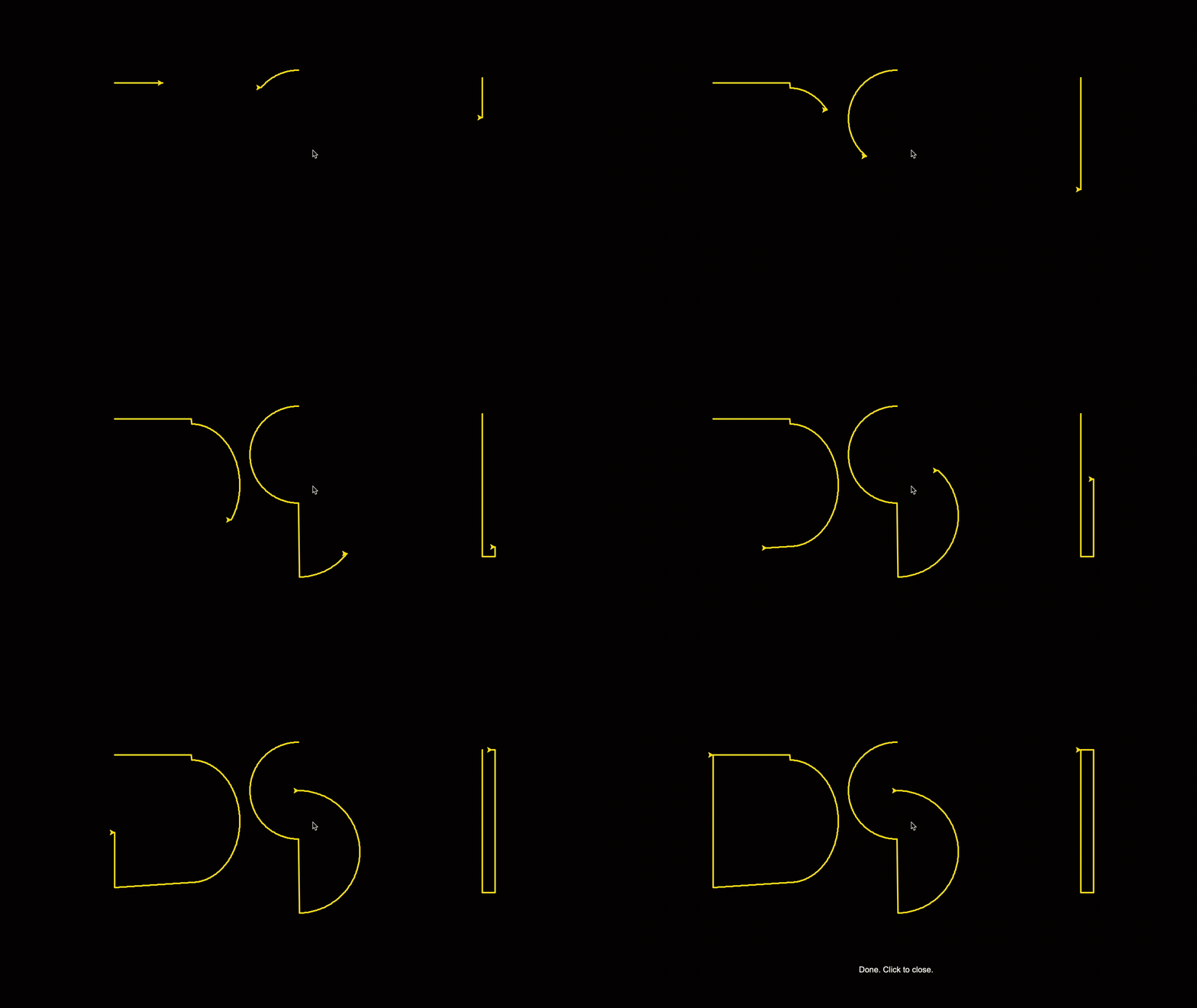
Algorithmic logic often implies the use of code, but not always. Rune Madsen distinguishes between typefaces generated entirely through code, without reference to an existing font, and those created by loading and manipulating an existing typeface (Madsen, n.d.). Below is a motion graphic with the letters “DSI” generated using a Python program, illustrating how coding can be adopted as a typography design tool.
Curious about more responsive, dynamic, and playful typefaces? Here’s a sneak peek at the website of Existential Co: https://www.existentialco.com/
Pereira et al. (2019) even developed a computational system that allows the algorithmic creation of glyphs from typographical skeletons using different generative drawing techniques. Take a look at more of them: https://cdv.dei.uc.pt/2019/letterspecies/
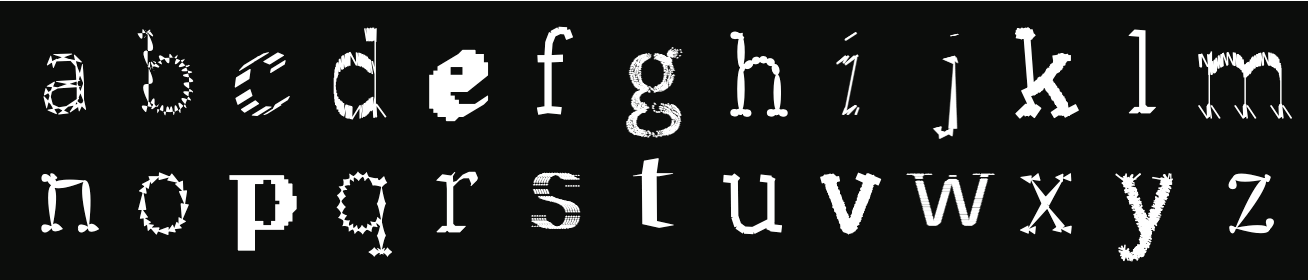
Despite the seemingly central role played by technology and programming, algorithmic typography is not about downloading pre-packaged commands and running them blindly. Ultimately, it is human thinking and creativity that matter most. These tools are powerful, but how they are driven, and to what ends, remains an open question for designers.
Computer science does not emancipate us from asking and being asked, “What is worth making, and why?” Instead, it pushes us further into a deeper inquiry: What counts as creativity in this era, and what makes us real creators?
Deconstructing and reconstructing letterforms creates unique typographic elements challenging traditional readability.
- Fiveable Content Team (Fiveable, 2024)
Employing code as a design method does not mean putting the computer in charge. Computers do not “see” or “understand” letters the way humans do. Through programming, designers teach computers how to translate ideas into form, much like explaining what the letter “D” looks like to someone who has never seen it before.
Here is the process of “teaching” a computer the movement path that constructs the letters “DSI.” You hand them two chess pieces and give step-by-step instructions for how to move those pieces so their trails form the shapes.
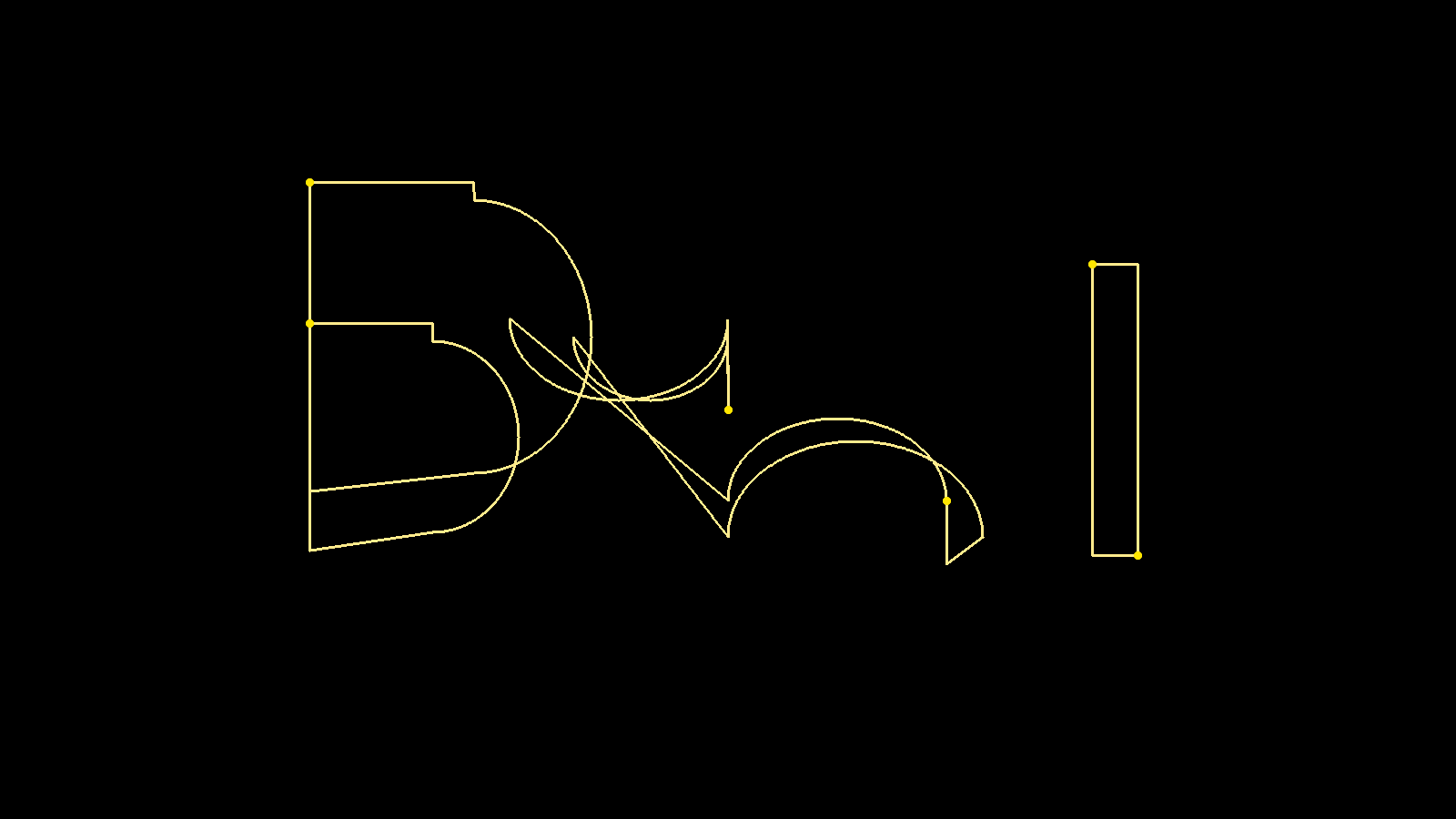
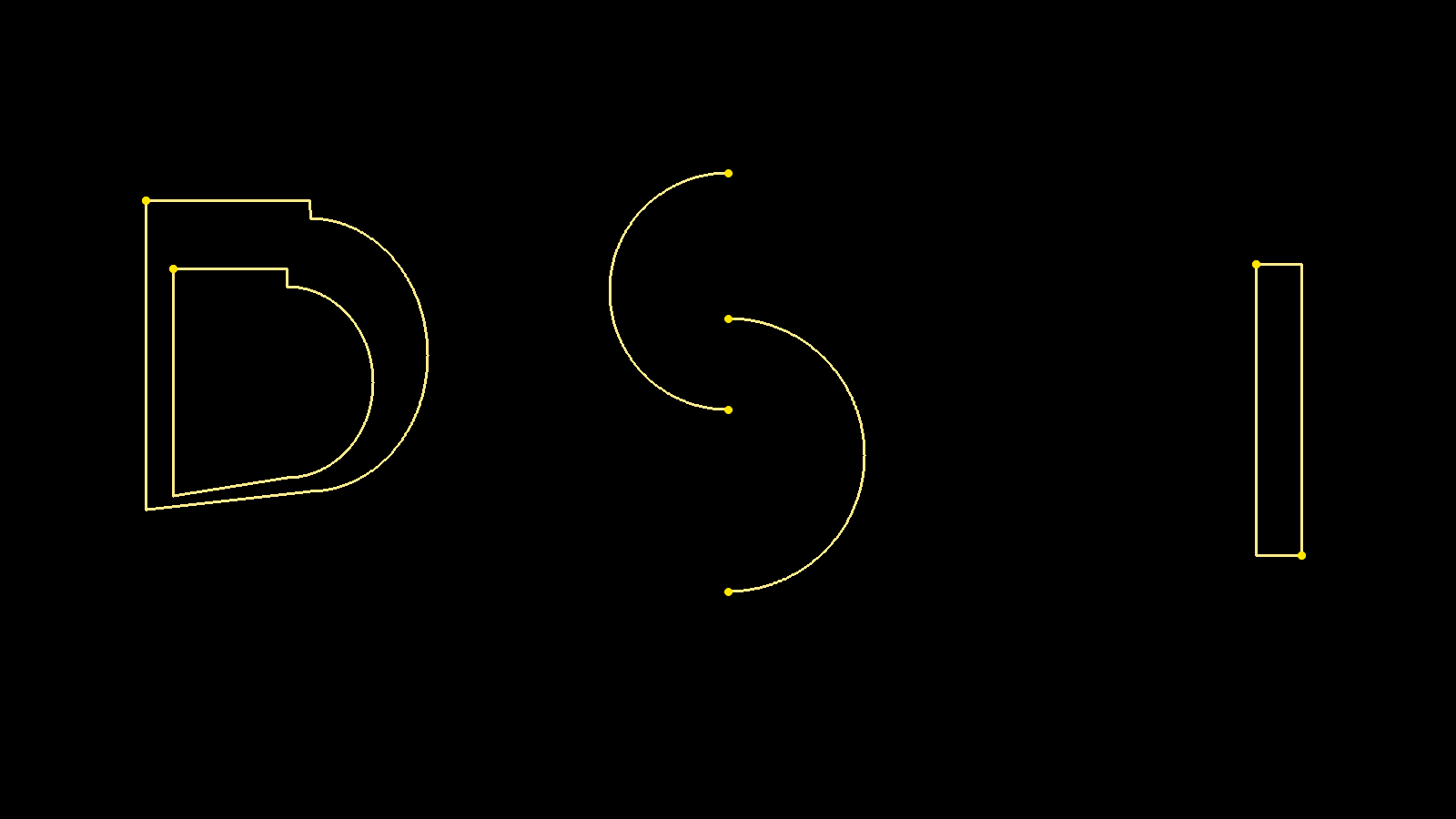
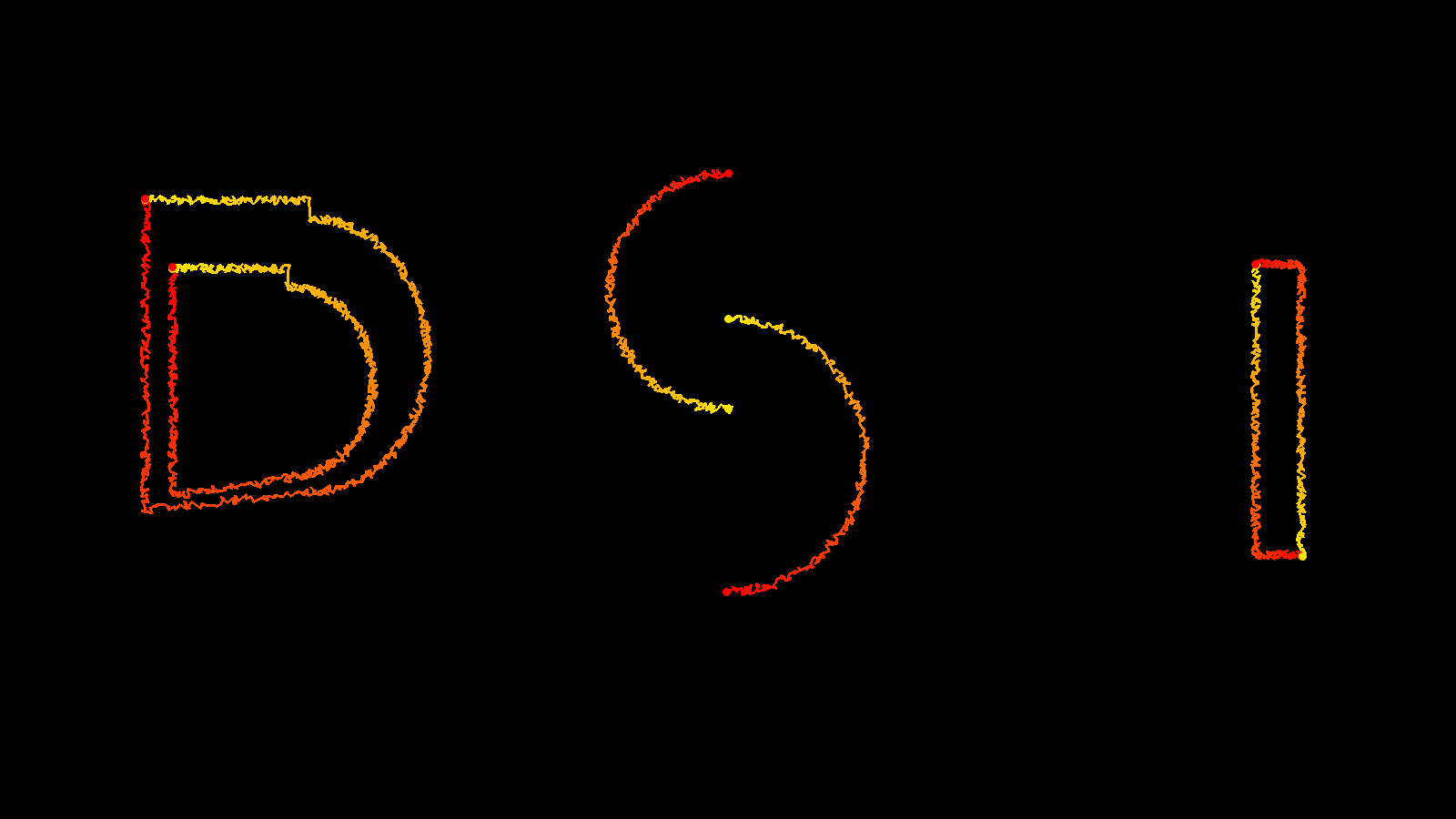
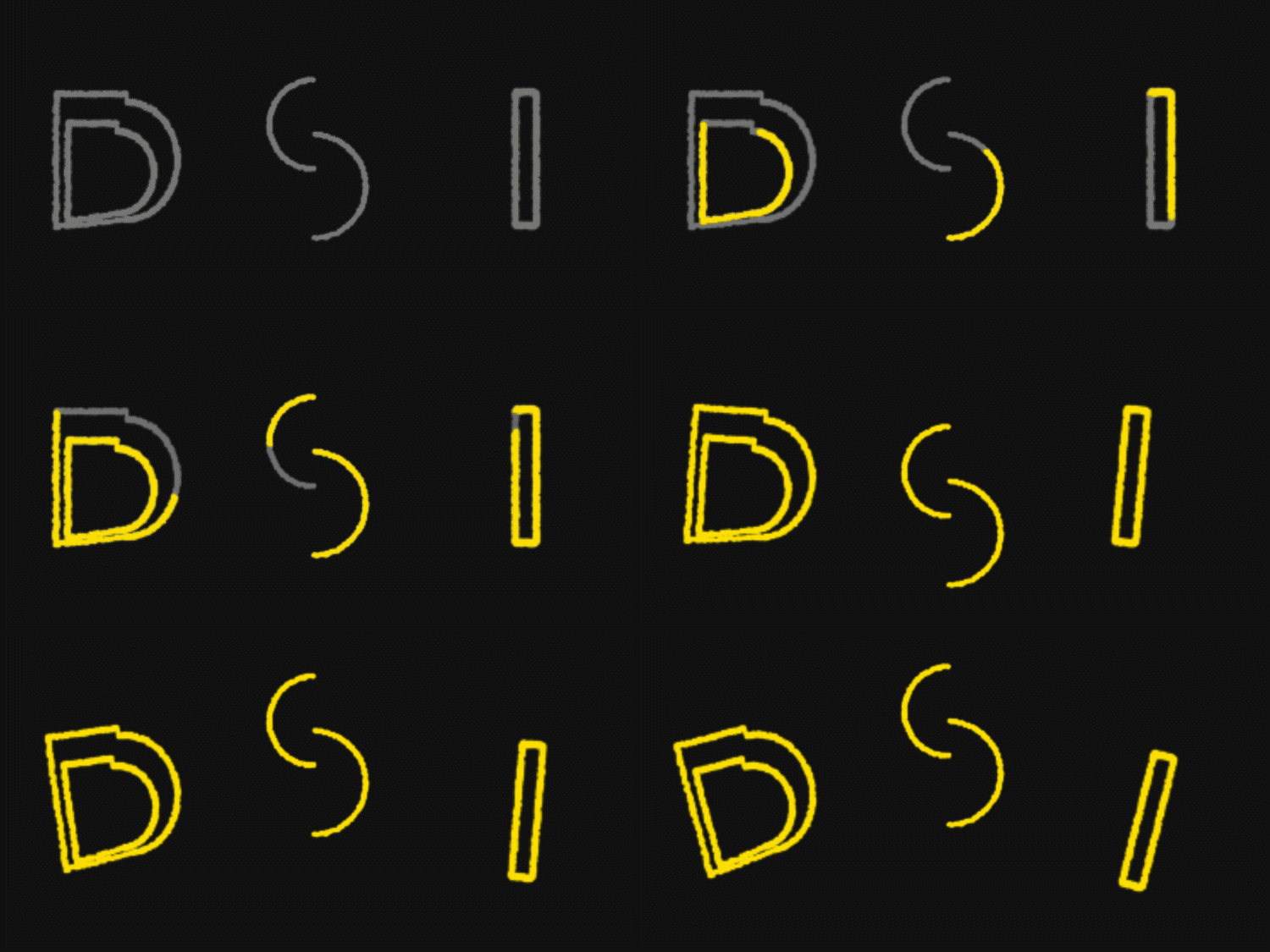
Once the shapes of letters are no longer taken for granted, the design space opens up. Small changes in rules can produce unexpected results. For example, an early attempt to draw “S” as two semicircles failed in a way a human designer would almost never make, yet that failure proved useful. It exposed underlying assumptions and pushed the design toward new possibilities. What happens if a slight shake is added to the motion, or a gradient is introduced so the letters shift color as they form? What happens if a few motions are added?
A small but useful trick: These letters generated in Python are, at their core, lists of points. In other words, each letter is a sequence of coordinates like [(x1, y1), (x2, y2)...], which is exactly how vector graphics work. A vector file stores geometry such as coordinates, lines, curves, and drawing rules such as stroke colors, width, shake. Therefore, these Python-generated letterforms can be directly exported as SVG paths, then brought into Adobe tools such as Illustrator and After Effects to create more visual effects. There are definitely other ways to draw letters with code, and the techniques for adding motion depend on how these letters are constructed in the first place. While AI-powered tools and “vibe coding” features have made programming more accessible and lowered many technical barriers, understanding the underlying rules still matters.
In an era saturated with online information floods, erratic letterforms with deliberately reduced readability invite readers to slow down and process information more carefully. By disrupting habitual skimming, these experiments interrupt patterns of digital consumption and temper impulsive reactions.
We are witnessing the shear between the history of computer science as a discipline, concerned with the nature and optimality of algorithms, and the new reality of computer programming as a skill, a form of basic literacy with practical utility (and idioms) in every field.
- Golan Levin and Tega Brain (Levin & Brain, 2021)
Long before typography responded to code or data, artists were already experimenting with movement, temporality, and interaction. As text entered time-based and audiovisual media, typography began to operate dynamically rather than remaining fixed on the page (Martins & Brandão, 2023). Avant-garde movements transformed visual perception and reconfigured how audiences read and interpret form, preparing viewers for “impure” or “corrupted” letterforms (Parente et al., 2018). These early explorations laid the groundwork for the emergence of algorithmic and responsive typographic systems.
With the development of computer science and its diffusion into every corner of life, artistic engagement with computation and emerging technologies has opened a new gateway for art and design. Computers are no longer limited to supporting creative work but have become directly involved in the act of creation, an activity once considered exclusive to humans.
Algorithmic typography emerges from this broader field of computational art and design, while developing properties specific to letterforms. Whereas computational design can generate images, sounds, or interactive systems, algorithmic typography applies these principles directly to the construction of letters. Moreover, generative or algorithmic programming does not necessarily depend on computers. It refers more generally to a sequence of predefined instructions that enable the production of multiple combinations (Curralo, 2022). In typography, this means that the design object is no longer only a finished font but also a process of iteration and a design strategy.
Unlike traditional font design, which originates in handwriting and later incorporates grids, mechanical typesetting, and early digital tools, algorithmic typography reduces direct manual control over individual letterforms. Designers no longer shape each glyph directly. Instead, they design and adjust the rules that govern how letterforms are generated. This shift does not restrict typographic design. On the contrary, developments in technologies such as machine learning models, programming libraries, artificial intelligence, and OpenType SVG (Adobe Creative Cloud, 2019), which allows color, gradients, texture, and transparency to be embedded directly in glyphs, make typographic experimentation more accessible (Brown, 2017). As a result, designers gain greater freedom to explore conceptual approaches to type.
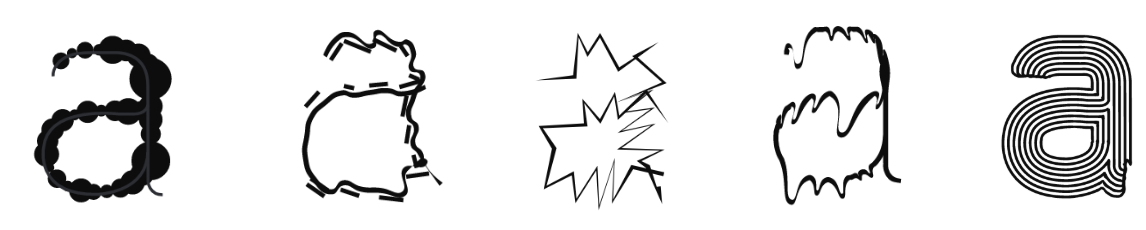
Using typEm as an example, Maçãs et al. (2019) display how algorithms allow typography to become responsive to meaning and affect. In sequence these glyphs represent happiness, fear, rage, disgust, and surprise.
Parente et al. (2019) use demographic data as a generative material for typeface design. In the example on the left, modules (punctuation marks) encode students’ genders, while color represents nationality and module density indicates the number of students. In the example on the right, these mappings are rearranged: modules represent nationality, color represents gender, and density again corresponds to student count. Algorithms enable typefaces to become a visual site for diversity.

Algorithmic typography is not about handing creativity over to machines. It is about making the rules visible, questioning the assumptions behind letterforms, and using systems, coded or not, as tools for exploration. When letters are treated as processes rather than fixed shapes, typography becomes a site of experimentation, reflection, and deliberate attention. What matters, in the end, is not how stunning the technological tools are, but how provocative our thoughts and imagination can be, and how reflexively the algorithms are applied.
Feel free to create your own fonts with algorithmic methods!
References
Adobe Creative Cloud. (2019, Feb 19). The Future of Typography with Dan Rhatigan | Adobe Creative Cloud, [Video]. YouTube. Retrieved Feb 3, 2026, from https://www.youtube.com/watch?v=UN_YP48vm-c&t=790s
Amado, P., Silva, A. C., & Quelhas, V. (2021). Post-Digital Letterpress Printing: Research, Education and Practice (1st ed.). Routledge. https://doi.org/10.4324/9781003173113
Brown, E. (2017, June 20). Algorithm based designs | designmantic: The design shop. DesignMantic. Retrieved January 29, 2026, from https://www.designmantic.com/blog/algorithm-based-designs/
Brain, T. (2018). The Environment Is Not A System. A Peer-Reviewed Journal About, 7(1), 152–165. https://doi.org/10.7146/aprja.v7i1.116062
Curralo, A. F. (2022). Typography design: An Algorithmic approach. In J. Neves, R. Dias, D. Raposo, R. Silva & L. Correia Castilho (Eds.), Advances in design, music and arts II (pp. 178-190). Springer International Publishing AG. https://doi.org/10.1007/978-3-031-09659-4_14
Demaine, E. D., & Demaine, M. L. (2015). Fun with fonts: Algorithmic typography. Theoretical Computer Science, 586, 111-119. https://doi.org/10.1016/j.tcs.2015.01.054
Demaine, E. D., Demaine, M. L., & others (2023). Mathematical and puzzle fonts/typefaces. Retrieved January 29, 2026, from https://erikdemaine.org/fonts/
Digital witness: Algorithmic spaces for typography and language. (n.d.). ArtCenter College of Design. Retrieved January 28, 2026, from http://www.artcenter.edu/connect/college-news/digital-witness-algorithmic-spaces-for-typography-and-language.html
Digital witness: Algorithmic spaces for typography and language - hoffmitz milken center for typography. (n.d.). Retrieved January 28, 2026, from https://hmctartcenter.org/exhibitions/digital-witness-algorithmic-spaces-for-typography-and-language
Fiveable. (July, 2024). Expressive and experimental typography | art direction class notes. Retrieved February 2, 2026, from https://fiveable.me/art-direction/unit-5/expressive-experimental-typography/study-guide/EhoQde7iLoPUdEJr
Kowalski, R. (1979) “Algorithm = logic + control,” Communications of the ACM, 22(7), pp. 424–436. Available at: https://doi.org/10.1145/359131.359136
Kyuha (Q) shim. (n.d.). Retrieved January 29, 2026, from https://kyuhashim.com/
Madeson, R. (n.d.). Typography. Retrieved February 3, 2026, from https://printingcode.runemadsen.com/lecture-typography/
Martins, A., & da Silva, B. M. (2023). Digital wor(l)ds: Using dynamic typography as a Mean of Artistic expression in Digital and Audiovisual settings. In N. Martins, & D. Brandão (Eds.), Advances in design and digital communication III (pp. 792-804). Springer. https://doi.org/10.1007/978-3-031-20364-0_66
Parente, J., Martins, T., & Bicker, J. (2018). Data-Driven Logotype Design. 2018 22nd International Conference Information Visualisation (IV), 64–70. https://doi.org/10.1109/iV.2018.00022
Parente, J., Martins, T., Bicker, J., & Machado, P. (2019). Designing Dynamic Logotypes to Represent Data: International Journal of Art, Culture, Design, and Technology, 8(1), 16–30. https://doi.org/10.4018/IJACDT.2019010102
Pereira, F. A., Martins, T., Rebelo, S., & Bicker, J. (2019). Generative Type Design: Creating Glyphs from Typographical Skeletons. Proceedings of the 9th International Conference on Digital and Interactive Arts, 1–8. https://doi.org/10.1145/3359852.3359866
Rune Madsen. (n.d.). Typography. Retrieved February 2, 2026, from https://printingcode.runemadsen.com/lecture-typography/
Stinson, L. (2015). Harnessing algorithms to create shape-shifting typography. Wired. Retrieved January 28, 2026, from https://www.wired.com/2015/03/using-algorithms-design-responsive-typography/
Typographics. (2022, June 18). Typographics 2022: Beneath the Code: Generative Typography with Lynne Gun, [Video]. YouTube. Retrieved Jan 29, 2026, from https://www.youtube.com/watch?v=sPvviXAA3oM&t=79s
TypeRoom. (2021, Oct 29). Data and logic in type: Kyuha Shim on his amazing algorithmic typographic quest - TypeRoom. Retrieved February 2, 2026, from https://www.typeroom.eu/data-logic-type-kyuha-shim-algorithm-typography