By: Mitchell Godbold
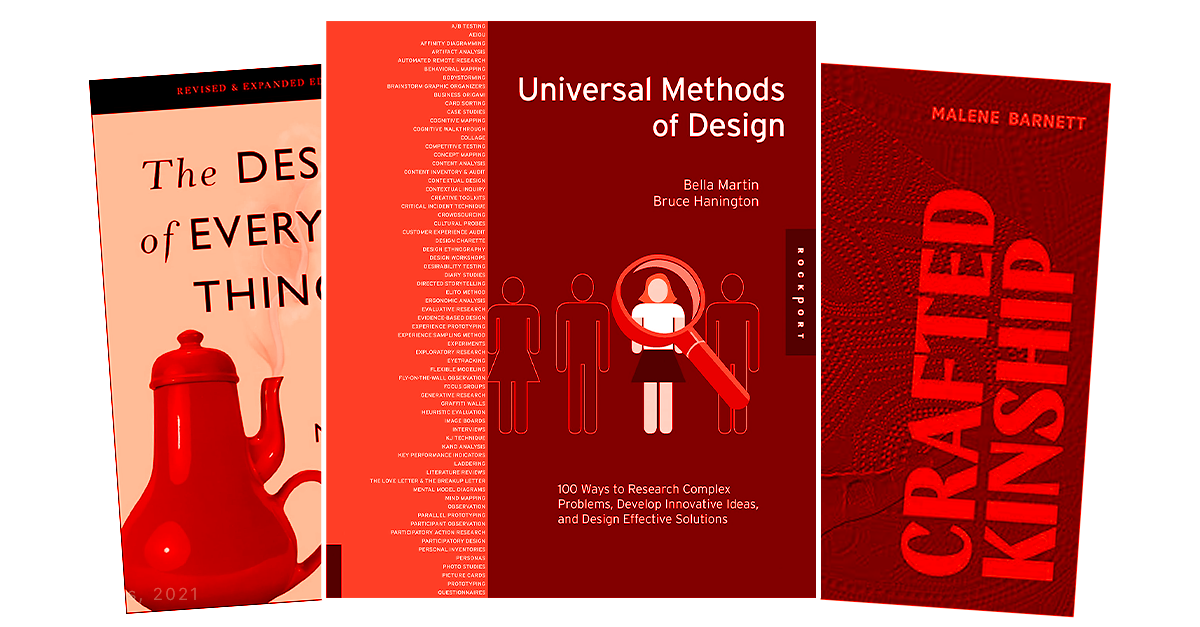
Finding the right design book isn’t always easy. We asked Dr. Jonathan Williams, the Dean of the Design Studies Institute, what books were on his desk. Whether you’re a seasoned designer or just starting, these titles are well worth a read. These books take a nice, timeless approach to design thinking, with similar approaches you’ll find throughout the curriculum at the Design Studies Institute. If you were wondering if these books were quite literally on the Dean’s desk…the answer is yes!
Author: Malene Barnett
Crafted Kinship is an ideal read about craftspeople across the Caribbean. It offers a thoughtful exploration of the diverse arts of the region, from the African heritage incorporated into its design motifs to fresh perspectives on remaking old labels and frontiers in the field. Barnett’s practice of mixing boundary-defining palettes and an abundance of carefully selected photos of artists showcasing their works really makes this book stand out as an encapsulation of Caribbean design. Crafted Kinship is a fun read for someone looking to expand and complicate their understanding of design.
Authors: Bella Martin & Bruce Hanington
Designs are rarely ever the same, but certain challenges have a way of showing up again and again. That’s where this design methodology playbook comes in, which can be a real lifesaver for navigating the design thinking process. Both authors of the book have storied backgrounds within the design education field. For example, Hanington is a professor at the well-known Carnegie Mellon University. His work focuses on the societal role that design plays. Inside, you’ll find clear breakdowns of tools like Affinity Diagramming, Image Boards, Parallel Prototyping, Weighted Matrices, and more, all explained in simple, practical terms. That is why the Dean recommends you take a copy; this is a book that can help you from the start of your design process right through to all stages of your career.
Author: Don Norman
It's nearly impossible to study design without encountering the name Don Norman. User-centered design's father, Norman, continues to remind us of the importance of creating products that serve people, and not the other way around. By co-founding the Nielsen Norman Group, he has shaped how designers approach usability as well as human behavior, penning countless instructional articles that break down design principles so that even beginners and industry experts can understand them. In his classic book, The Design of Everyday Things, Norman speaks to us of how "good design is actually a lot harder to notice than poor design … good designs fit our needs so well that the design is invisible, serving us without drawing attention to itself."
Of course, these three books are just suggestions; there are plenty of valuable design resources out there in the world that can be as broad or as challenging as possible. Regardless of your design readings, the offerings at Design Studies Institute are structured to support your design endeavors. Discover our offerings of degrees and certificates at https://www.dsi.edu.ai/.